




As the demand for recycled metals continues to grow, efficient scrap metal recycling has become increasingly important for industries, recycling companies, and waste management facilities. Scrap metal from end-of-life vehicles, machinery, appliances, construction projects, and manufacturing processes contains valuable ferrous and non-ferrous metals that can be recovered and reused.
But how does a Scrap Metal Recycling Plant recycle scrap metal efficiently? The answer lies in a combination of advanced shredding, screening, magnetic separation, eddy current separation, air classification, and other sorting technologies. By integrating these processes into a complete recycling system, valuable metals can be recovered while unwanted materials are separated from the final products.
A Scrap Metal Recycling Plant is an integrated system designed to process different types of metal-containing waste and recover valuable materials for reuse.
Depending on the feedstock, a recycling plant may process:
Scrap steel and iron
Scrap aluminum
Copper and other non-ferrous metals
End-of-life vehicles
Waste electrical appliances
Industrial metal scrap
Construction and demolition waste
Mixed metal waste
The plant configuration is usually customized according to the type, size, composition, and processing capacity of the incoming scrap. Different materials require different combinations of crushing, shredding, screening, and separation equipment.
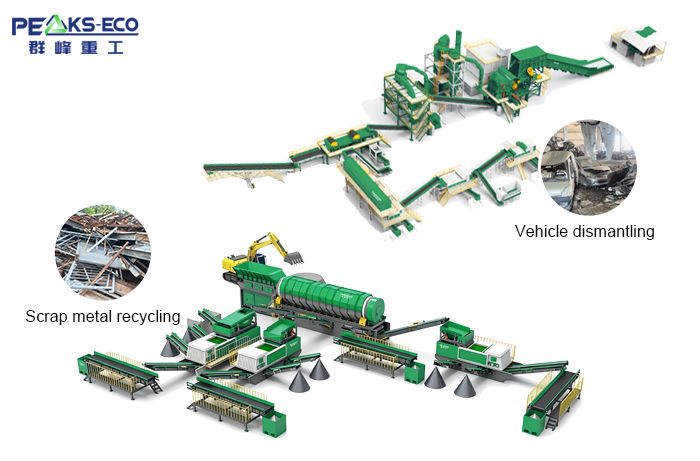
A modern scrap metal recycling process generally consists of several interconnected stages. Each stage has a specific purpose, from reducing the size of bulky scrap to separating valuable metals from non-metallic contaminants.
The recycling process begins with the feeding of scrap metal into the production line.
Large or bulky materials may first undergo manual inspection or pre-sorting to remove unsuitable items. A controlled feeding system then delivers the material into the shredding equipment at a consistent rate.
Stable feeding is essential because it helps prevent equipment overload and ensures that downstream processing equipment receives a relatively uniform material flow.
For complex waste streams such as end-of-life vehicles or mixed household appliances, preliminary dismantling may also be required to remove hazardous or unsuitable components before mechanical processing.
Shredding is one of the most important steps in scrap metal recycling.
Large metal objects can contain different materials that are connected or compressed together. A heavy-duty shredder breaks these materials into smaller pieces, making them easier to separate.
For example, an automobile body may contain steel, aluminum, plastics, rubber, glass, textiles, and other materials. After shredding, these components become much easier to separate using mechanical and physical sorting technologies.
The appropriate shredder depends on the characteristics of the incoming material. Heavy-duty shredders can be used for bulky scrap, while specialized shredding equipment can be selected for lighter or more complex materials.
After shredding, the material is often sent through a screening system.
Screening separates materials according to particle size and helps create a more uniform feed for subsequent separation processes. Depending on the application, vibrating screens, trommel screens, disc screens, or other screening equipment can be used.
Effective screening improves the overall efficiency of the recycling line because different particle sizes can be directed to the most appropriate downstream processing equipment.
Magnetic separation is a fundamental technology in scrap metal recycling.
Ferrous metals such as iron and steel respond to magnetic fields and can therefore be separated from non-magnetic materials using magnetic separators.
A magnetic separator can continuously remove ferrous metals from a mixed shredded material stream. The recovered steel and iron can then be collected as a separate product for further processing.
This process offers several advantages:
Efficient recovery of iron and steel
Continuous automated operation
Reduced manual sorting
Improved purity of non-ferrous material
Better overall resource recovery
For recycling plants processing large quantities of steel-containing scrap, magnetic separation is an essential part of the system.
After ferrous metals have been removed, the remaining material may still contain valuable non-ferrous metals.
Aluminum, copper, brass, and other non-ferrous metals cannot be separated using conventional magnetic separators. An eddy current separator can therefore be used to recover non-ferrous metals from the remaining material stream.
Eddy current separation works by generating a magnetic field that interacts with electrically conductive metals. This creates a repelling force that separates non-ferrous metal particles from lighter non-metallic materials.
This technology is particularly useful for recovering aluminum from mixed scrap and can significantly increase the value of the recovered material.
Scrap metal streams often contain lightweight contaminants such as plastic, rubber, paper, textiles, and foam.
Air separation technology uses differences in density and aerodynamic behavior to separate lightweight materials from heavier fractions.
The heavier metal-rich materials remain in the main processing stream, while lightweight materials are carried away by controlled airflow.
This process helps improve the purity of recovered metals and reduces the amount of non-metallic contamination in the final products.
Small metal particles can be generated during shredding and screening. Without additional recovery processes, some of these fine materials may be lost with residual waste.
A properly designed recycling system can incorporate additional screening and separation technologies to recover valuable fine metals.
Fine material recovery is particularly important when the recycling plant aims to maximize overall metal recovery and improve the economic value of the operation.
Efficient recycling is not simply about shredding scrap metal. The complete system must be carefully designed so that each processing stage works together.
Proper shredding improves the liberation of different materials. If scrap is not sufficiently reduced in size, metal may remain attached to plastic, rubber, or other materials, making separation more difficult.
Using multiple separation technologies allows different materials to be recovered according to their physical properties.
For example:
Magnetic separation → ferrous metals
Eddy current separation → non-ferrous metals
Air separation → lightweight materials
Screening → different particle sizes
Combining these technologies provides a more comprehensive recovery process than relying on a single sorting method.
Conveyors and automated feeding systems maintain a stable material flow throughout the plant. This reduces interruptions and helps improve processing efficiency.
Automation can also reduce labor requirements and provide more consistent operating conditions.
Different scrap materials have different characteristics. A recycling line for clean aluminum scrap may require a completely different configuration from a system designed for end-of-life vehicles or mixed industrial scrap.
Therefore, plant design should take into account:
Feedstock composition
Material size
Moisture content
Metal content
Required capacity
Target product purity
Available installation space
Final product requirements
A well-designed Scrap Metal Recycling Plant can produce several valuable material streams.
Steel and iron are commonly recovered using magnetic separation. These materials can be supplied to steel mills and other metal-processing industries.
Aluminum can be recovered from vehicles, appliances, construction materials, industrial scrap, and other sources. Eddy current separation is commonly used to separate aluminum from mixed material streams.
Copper may be present in electrical components, cables, motors, appliances, vehicles, and industrial equipment. Depending on the feedstock, additional sorting technologies may be required to achieve the desired recovery and purity.
Brass, zinc, and other valuable non-ferrous metals may also be recovered depending on the composition of the incoming scrap and the configuration of the recycling system.
Plastics, rubber, textiles, foam, and other lightweight materials can be separated from the metal-rich fractions. Depending on their quality and local recycling infrastructure, some of these materials may also be recovered for further processing.
End-of-life vehicles contain large quantities of steel, aluminum, copper, plastics, rubber, and other materials. After suitable dismantling and preparation, vehicle scrap can be shredded and processed through multiple separation stages.
An integrated recycling system can recover ferrous and non-ferrous metals while separating lightweight residual materials.
Steel scrap from demolition, manufacturing, machinery, and other sources can be processed using shredding and magnetic separation technologies.
The recovered ferrous fraction can then enter the steel recycling supply chain.
Aluminum scrap can come from profiles, castings, vehicle components, appliances, and manufacturing offcuts. Efficient separation helps produce cleaner aluminum fractions for further recycling.
Manufacturing facilities generate metal offcuts, rejected products, machining waste, and mixed industrial scrap. Recycling these materials allows manufacturers and recyclers to recover valuable metals instead of sending them to disposal.
Construction and demolition activities generate steel structures, aluminum components, cables, pipes, and other metal-containing materials. A dedicated recycling system can recover these metals and reduce the amount of waste requiring disposal.
Investing in an efficient recycling system can provide both environmental and economic benefits.
Advanced shredding and separation technologies can recover a greater proportion of valuable metals from mixed waste streams.
Recovering recyclable metals reduces the amount of material sent to landfill or other disposal facilities.
Multi-stage sorting removes contaminants and produces cleaner metal fractions that are more suitable for downstream recycling.
Automated feeding, shredding, magnetic separation, eddy current separation, and air classification can reduce dependence on manual sorting.
Instead of selling mixed scrap as a single material, operators can separate it into different product streams such as steel, aluminum, copper, and other recyclable materials.
Recycling scrap metal reduces dependence on virgin raw materials and keeps valuable resources within the production cycle for longer.
Choosing the right recycling system depends heavily on the characteristics of the feedstock.
Before selecting equipment, operators should consider:
What type of scrap will be processed?
End-of-life vehicles, steel scrap, aluminum scrap, appliances, and industrial waste require different processing configurations.
What is the required capacity?
The capacity of shredders, screens, conveyors, and separators should match the expected throughput.
What purity is required?
Higher-quality recycled products may require additional separation stages.
What metals need to be recovered?
The system should be designed according to the target ferrous and non-ferrous metal fractions.
What level of automation is required?
A fully automated system can reduce labor requirements and improve operational consistency, while simpler systems may be suitable for smaller operations.
A Scrap Metal Recycling Plant works most efficiently when its individual machines are designed as one complete system.
A typical integrated process can be summarized as:
Feeding → Shredding → Screening → Magnetic Separation → Eddy Current Separation → Air Separation → Fine Material Recovery → Final Products
Each stage contributes to the overall recovery efficiency. Proper equipment selection and plant layout can help reduce material losses, improve product quality, and maintain stable operation.
PEAKS-ECO provides customized recycling solutions for different scrap metal streams and can integrate shredding, conveying, magnetic separation, eddy current separation, air separation, and other technologies according to project requirements.
So, how does a Scrap Metal Recycling Plant recycle scrap metal efficiently?
The key is the integration of multiple technologies. Scrap metal is first fed into the system and reduced in size through shredding. Screening then separates materials by particle size, while magnetic separators recover ferrous metals. Eddy current separators can recover non-ferrous metals such as aluminum, and air separation helps remove lightweight contaminants. Additional sorting and fine material recovery can further improve the quality and recovery rate of the final products.
A well-designed Scrap Metal Recycling Plant does more than process waste. It transforms discarded materials into valuable secondary raw materials, helping recycling companies improve resource recovery, reduce disposal volumes, and support a more sustainable circular economy.
For companies looking to establish or upgrade a scrap metal recycling facility, choosing a customized system based on the actual feedstock, processing capacity, and target products is essential for achieving efficient and reliable recycling performance.