



In the transition to a circular economy for plastics, it is crucial to promote the integration of various plastics into a closed-loop system. Polystyrene (PS) and acrylonitrile-butadiene-styrene (ABS), as widely used and high-value plastics, share some commonalities in their recycling pathways but also face different challenges.
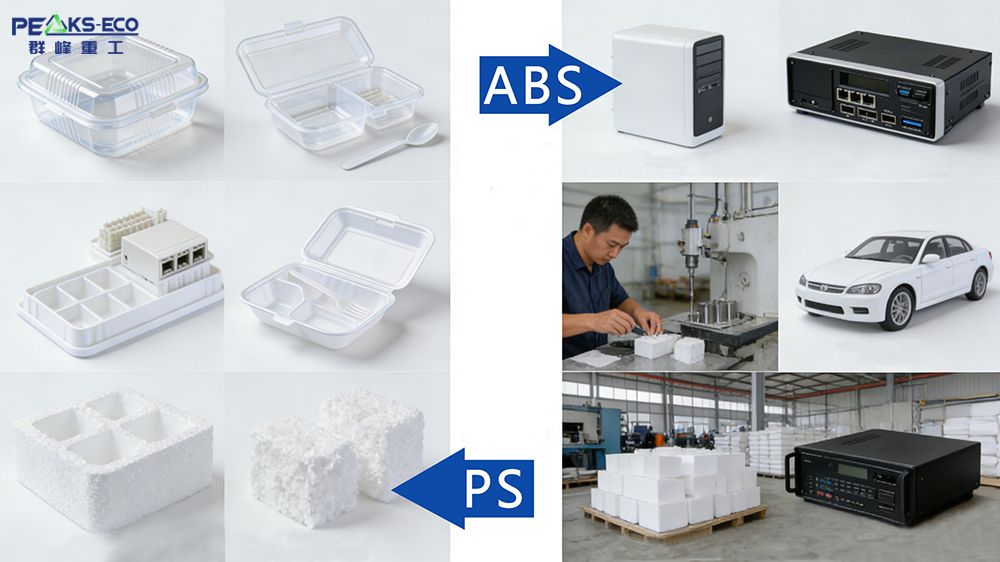
PS is low-cost and highly transparent, widely used in packaging, tableware, and building materials. Its expanded polystyrene (EPS) foam is lightweight and fluffy, making transportation and storage inconvenient during recycling.
ABS has excellent performance, is impact-resistant, and easy to process, primarily used in high-end applications such as electrical appliances, electronic equipment, and automotive parts.
Both PS and ABS are often found mixed in waste household appliances, such as television and refrigerator casings; therefore, they are often treated as "mixed hard plastics" during initial recycling.
Pretreatment and Cleaning: After crushing, the mixed waste is separated into lower-density PS and ABS by brine flotation, followed by hot washing to remove surface coatings and impurities.
Deep Purification: After cleaning, the fragments are rinsed, dehydrated, and dried to ensure the material is clean and dry.
Key Sorting: Electrostatic separation is the core process. Utilizing the difference in motion of plastics after triboelectric charging in different electric fields, high-purity separation of ABS and PS can be achieved, with a purity of over 99%, and it can also effectively process black plastics.
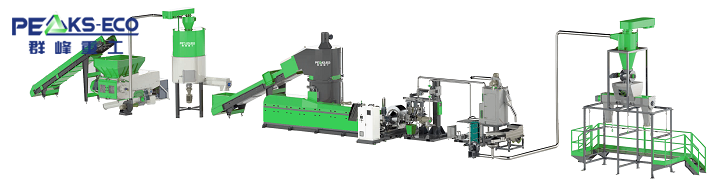
PEAKS-ECO's plastic granulation production line can process recycled plastics such as PE, PP, PVC, and ABS into films, rigid or foam-like recycled granules after cleaning. The production line equipment can be flexibly configured according to the raw material form, processing volume, and product requirements. Key processes include material crushing, drying, and extrusion granulation, among which the control of raw material form and humidity is crucial to production stability and finished product quality.
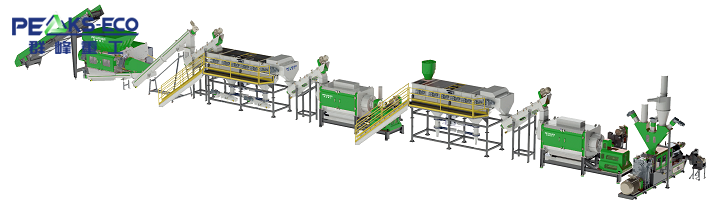
Rigid Plastics and Film Recycling Washing Line
This washing line processes rigid plastics and film waste made of LLDPE, LDPE, HDPE, and PP. The line effectively removes impurities and dehydrates materials through crushing, high-intensity washing, sedimentation and flotation separation, and professional drying. The cleaned fragments can be directly used for recycling and granulation, or used as dried material.
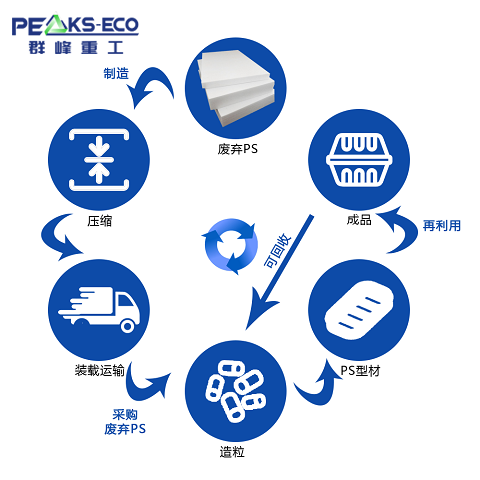
PS recycling is relatively mature, especially EPS, which can be recycled into building materials and other products after being compressed through "volume reduction melting", forming a closed business loop.
ABS recycling still faces bottlenecks. Although it is easy to regenerate, its sources are complex (mainly from waste electrical and electronic equipment), highly mixed, and heavily polluting. Many recycling companies lack efficient sorting and pre-processing capabilities, making it difficult to economically purify ABS, which is often downgraded or landfilled.
The fundamental difference lies in the fact that PS often originates from relatively clean industrial materials or sorted waste foam, while ABS comes from highly mixed electronic waste, requiring higher investment in recycling technology and equipment.
Promoting comprehensive ABS/PS recycling requires both technological breakthroughs and systemic support:
Technology Promotion: Optimize technologies such as electrostatic sorting to reduce costs and improve the sorting capacity for mixed materials and ferrous plastics.
Easy-to-Recycle Design: Encourage product design to consider disassembly and recycling, reduce material composites, and facilitate downstream sorting.
Policy Guidance: Promote supply chain participation through systems such as extended producer responsibility; establish recycled material standards to enhance market confidence.
Classified Collection: Improve the recycling system to enhance the quality of waste plastics from the source.
PS recycling has achieved initial commercialization, while ABS recycling, although technically feasible, is limited by the complexity of raw materials. By improving sorting technology, perfecting the recycling system, and strengthening policy and market coordination, waste PS and ABS can be transformed into high-value resources, promoting the development of a circular economy in the plastics industry, with both environmental and resource benefits.